




October
2026
The Alley Firefighter
1. Where Big Fire Trucks Can't Reach, Who Arrives First?
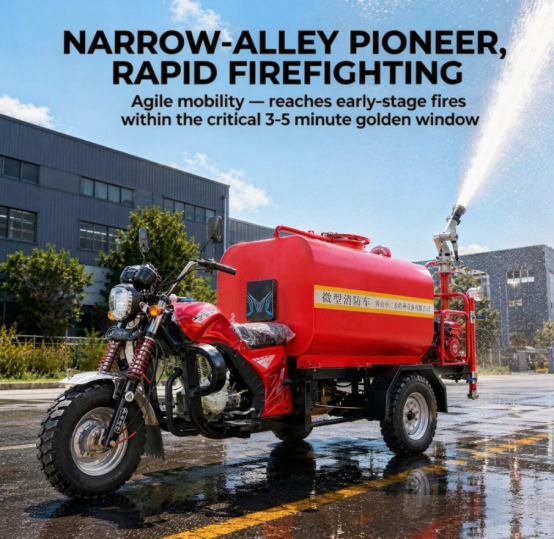
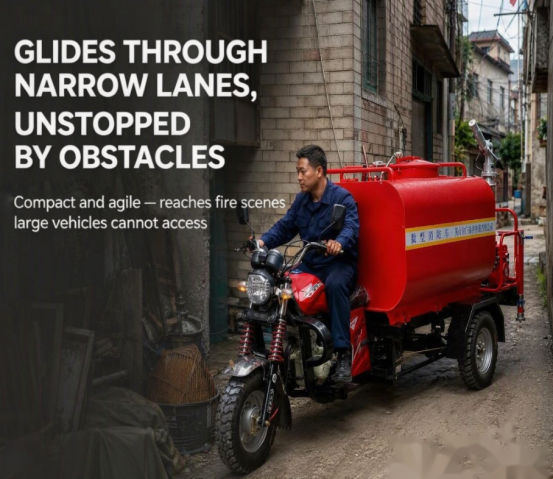
In townships, administrative villages and old urban neighbourhoods, roads are narrow and lanes run in every direction. Limited by vehicle width and turning radius, large fire trucks often cannot reach the fire in the first minutes. By the time access is cleared and the truck is brought to the doorway, a small fire has usually spread.
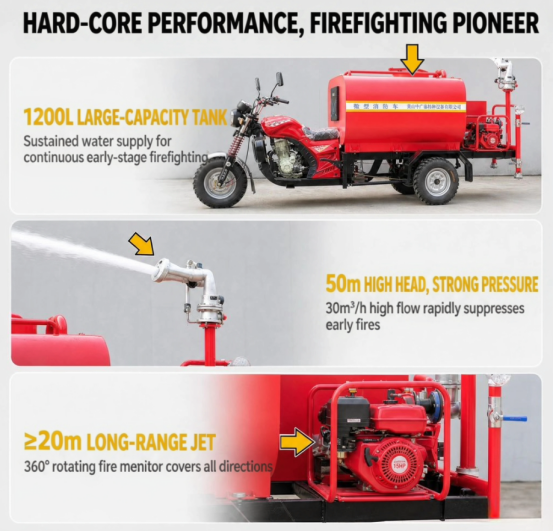
The tricycle mini fire truck was designed for exactly this situation. With overall dimensions of just 3,100 × 1,300 × 1,550 mm, a narrow body and agile steering, it slips through village roads, back alleys, internal factory lanes and the gaps between buildings. It reaches the scene within the first three to five minutes, starts firefighting immediately as the first responding unit, and buys valuable time until the professional fire service arrives.
2. Key Specifications
|
Item |
Specification |
|
Chassis type |
Petrol tricycle motorcycle, rear-wheel drive |
|
Overall dimensions |
3,100 × 1,300 × 1,550 mm (including bodywork) |
|
Tank capacity |
1,500 L |
|
Fire pump flow |
30 m³/h |
|
Pump head |
50 m |
|
Suction lift |
8 m (7 m maximum suction depth) |
|
Monitor straight-stream range |
≥ 20 m |
|
Monitor rotation |
360° horizontal, 0–90° elevation |
|
Fuel |
Petrol (separate fuel supply for chassis and fire pump) |
|
Operating temperature |
0 °C to +40 °C |
|
Finish |
Fire red with fire-service markings |
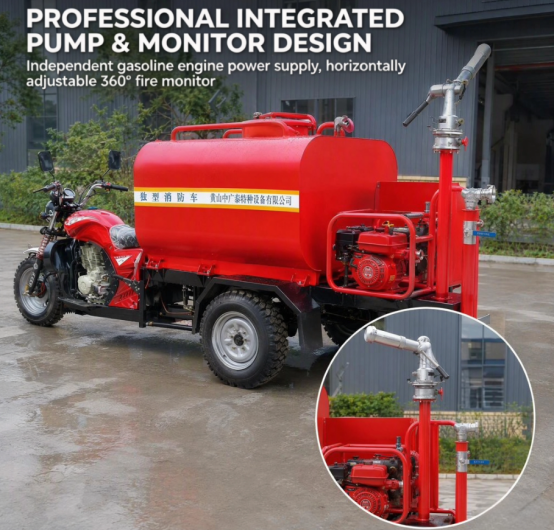
The most important design feature of this vehicle is that the driving system and the firefighting system are completely independent.
The chassis is driven by the tricycle motorcycle engine, while the fire pump is driven by its own single-cylinder, four-stroke air-cooled petrol engine. The two power units do not depend on each other — which means that even with the vehicle switched off and parked, the fire pump still runs and delivers water. The state of the chassis engine has no effect on the firefighting operation.
The fire pump comes with a 12 V electric vacuum priming device and releases pressure automatically when stopped. A drain plug at the bottom of the pump body allows complete draining for winter freeze protection. The electrical system only handles lighting and signals; it plays no part in driving the fire pump.
4. Three Water Sources — Go Wherever the Water Is
The 1,500 L on-board tank is the first line of defence. Once on scene, the vehicle can fight the fire directly from its own water, with no waiting for an external supply.
When the tank runs low, two further water sources are available:
Municipal hydrant supply: a 65 mm polyester-filament polyurethane hose connects to the hydrant. With inlet pressure kept below 0.4 MPa, the vehicle can refill its tank or supply water directly.
Open-water drafting from rivers and ponds: using the fire pump's 7 m maximum suction depth, water can be drawn straight from ponds, ditches, storage reservoirs and other natural sources for continuous, uninterrupted firefighting.
5. Roof Monitor: Straight Stream and Spray, One-Touch Switching
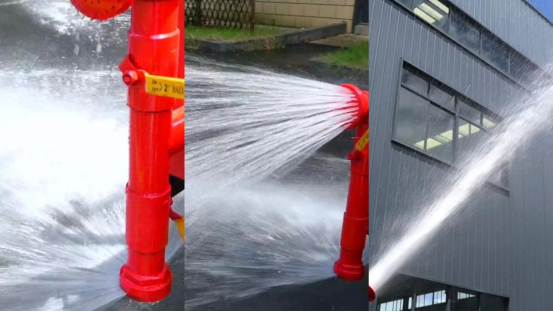
The roof-mounted monitor switches between straight-stream and spray mode at the touch of a button:
Straight-stream mode: a concentrated jet with a maximum range of ≥ 20 m, delivering a long-distance impact to knock down solid-material open flames.
Spray mode: an umbrella-shaped mist for large-area cooling, blocking combustible vapours and washing down spilled liquids on the ground. The monitor rotates a full 360° horizontally with no blind spots and adjusts from 0–90° in elevation — a single operator on the rear platform can aim it at the fire. Under all three supply modes — on-board tank, hydrant or open-water drafting — the piping system delivers high-pressure water to the monitor.
6. One Truck, Many Jobs: Never Idle Between Fires
Firefighting is the core function, but the vehicle's value does not stop there. Using the on-board tank, the independent fire pump and the complete water circuit of the monitor, it also handles:
● Road sprinkling for dust suppression and pavement washing
● Green-area irrigation and site cooling
● Spraying and dust control at refuse collection points
● Emergency water delivery
When there is no fire call, the vehicle serves as everyday municipal utility equipment for streets, villages and factory yards — so the investment never sits idle. With the monitor set to its wide spray pattern, the truck can spray on the spot when parked or lay water while moving at low speed.
7 Tank and Protection Details
The water tank is welded from 2.5 mm low-carbon steel plate with fully welded seams. The interior is coated with a food-grade epoxy anti-corrosion layer that withstands long-term immersion in clean water, resists rust and prevents scaling. The exterior uses high-temperature electrostatic red baking paint for wear and corrosion resistance. The tank is equipped with:
● Quick-open top manhole (rubber-sealed cover with quick-lock latches) for cleaning, inspection and overflow pipe servicing
● Automatic overflow drainage when overfilled, preventing spillage that would corrode the chassis while driving fully loaded
● Bottom drain ball valve: periodic discharge of sediment and rust from the tank floor to prevent clogging the fire pump impeller
● Multiple mounting brackets with rubber cushion pads, locked to the chassis frame to isolate road vibration
A dedicated protective equipment compartment inside stores fire suits, fire helmets, SCBA cylinders, fire gloves, fire boots, safety ropes and other gear.
A red flashing warning beacon on the roof alerts pedestrians and vehicles while the truck is responding.
Application Scenarios
Residential firefighting: compounds with narrow gaps between buildings, corridor and storage-room fires, e-bike self-ignition, and fires in old urban villages.
Township and village firefighting: fast knockdown of incipient fires on village roads, back alleys and internal factory lanes.
Long-distance water supply: as a relay supply unit in forest firefighting, refilling large fire trucks through long hose runs.
Municipal sanitation: dust-suppression sprinkling, green-area irrigation, emergency water delivery and other daily operations.

